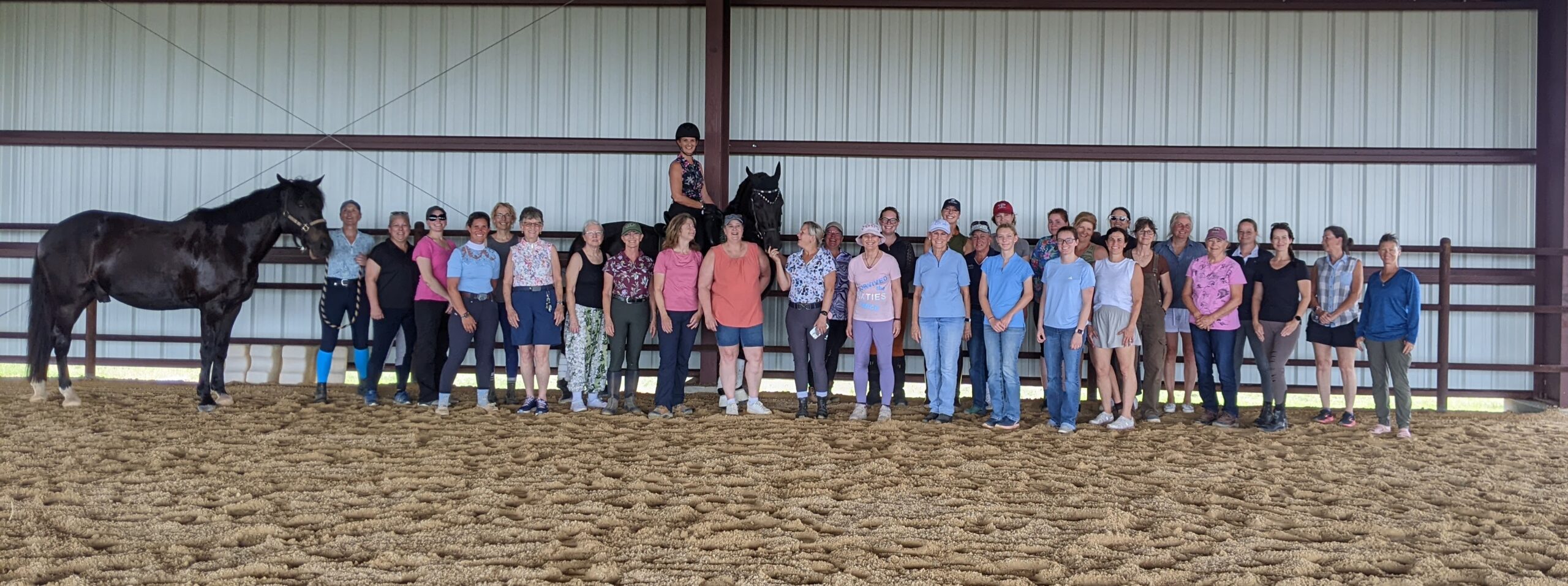
What the Horse Thinks: Lessons from the JJ Tate Symposium
How connection, biomechanics, and intention shape true dressage partnership
When you step into a JJ Tate symposium, you’re not just sitting in on a clinic—you’re entering a lineage of classical dressage. JJ brings the influence of her mentor, Charles de Kunffy, and all those who came before him weaving the teachings into a modern, empathetic, and biomechanically precise approach. Her instruction resonates deeply with today’s thoughtful riders.
Two core themes emerged across every lesson—from Training Level to Grand Prix:
- Rhythm We must develop the feel and timing to truly go with the horse. Every nuance matters when building connection and harmony.
- Rider Position & Biomechanics Small adjustments in rider posture created visible changes in the horses. A subtle tweak could shift a horse from slightly muddled and resistant to clearly expressive and balanced. We even witnessed improvements in gait quality.
JJ’s teaching style was consistently effective. She often delivered corrections chanting in rhythm, helping the rider stay present and focused on just one piece at a time. As a rider myself, I can say: I now ride with JJ’s voice in my head!
What follows are insights from the symposium—ideas that help us deepen our awareness, refine our aids, and step into a more honest, connected way of riding.
Create the Situation for the Horse to Seek the Bit
One of JJ’s key messages was this: “You don’t put the horse on the bit. You create the conditions that invite them to find it.”
Rather than chasing connection from the front end, JJ teaches us to close the gap between the hind leg and the bit. When the horse steps forward in balanced alignment, contact becomes a conversation—not a tug-of-war.
- If the horse leans on the bit, ask: “Can I put that energy into my seat bones?”
- Always ride: leg → seat → hand.
- The horse has every right not to accept the bit if we pull on it.
Mindset Before Mechanics
“All that matters is what the horse thinks. If we asked the horse’s opinion of the program, I’d hope they’d give it a thumbs up!”
This guiding principle shaped the entire weekend. Every aid we give should be considered from the horse’s point of view. Are they confused or clear? Waiting or rushing? Pulling or pushing?
True connection comes from feel—not force. And feel starts with the rider’s mindset. Resistance usually means the horse isn’t prepared or doesn’t understand.
The Rider as Conduit, Not Commander
In JJ’s words: “We ‘make them’ do it because we do it.” This means the rider’s body must embody the tensegrity needed to channel energy into the desired movement—not through coercion, but through clarity and alignment. It’s like leading a dance.
Key Corrections to the Rider’s Seat:
- Ride from the femurs. Ride the slabs of the horse’s shoulders with your femurs.
- Point your kneecaps down to set the right femur angle.
- Shorten stirrups if it’s difficult to maintain the correct position.
The Swivel Seat:
- Stay aligned with the bend by rising into it.
- At trot and canter, think: inside shoulder back, in rhythm.
- Riders improved by calling on their “Olympic body”—a visual to help them find their best seat.
Canter and Flying Changes
JJ described the canter as a wave—crashing forward, then pulling back. This visual helps riders feel the necessary cadence for clean, expressive changes.
Key takeaways:
- Own the canter for three strides before the change.
- If the horse struggles with one-tempis, the issue is often straightness or bend.
- Remember: canter is naturally bent. When we stop riding the bend, the canter falls apart.
- Shoulder-in improves canter.
- A successful flying change needs:
- A good-quality canter
- A clear, timely half halt
- A crisp, committed aid
- The horse must “attack” the ground to bounce into the change.
Final Thoughts: Conviction and Clarity
Most lessons followed a rhythm: rider position → foundational basics → movement to enhance basics → rider’s wish list.
JJ’s mastery of the basics is so internalized that she often began solving a rider’s issue before they even verbalized it. Her feel, paired with deep biomechanical understanding, made the teaching seamless and effective.
The feedback from riders and auditors was unanimous: “When is she coming back?” It was a joyful, information-rich weekend—cheered on by a supportive community and grounded in shared growth.
Special thanks to JJ Tate, our hosts Celeste and Tim Brown of Pine Meadow Farm, USDF, USDF Region 9 and the CTDS board for making this event possible.